Space news, with the sums shown
Voyager 1 and the one-light-day mark
NASA projects that on 18 November 2026 Voyager 1 will be one light-day from Earth. Here is what that means, with every number sourced.
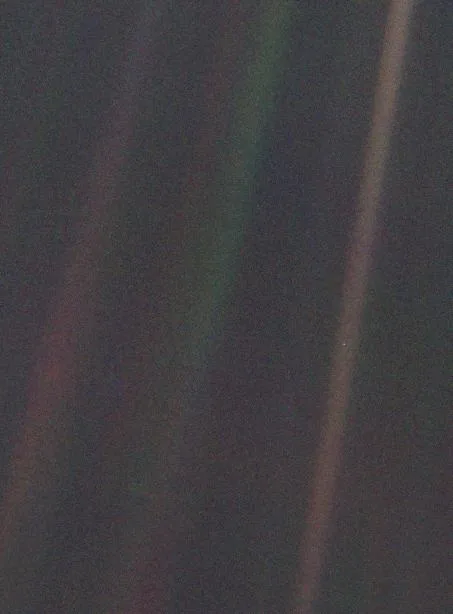
What is a light-day?
A light-day is the distance light travels in one day: 25,902,068,371 kilometres, which is about 25.9 billion km. Light moves at 299,792.458 km per second and a day has 86,400 seconds, so you multiply the two. [1]
Radio waves are light of a longer wavelength, so they travel at the same speed. That makes a light-day a measure of delay as well as distance: a radio message that crosses one light-day takes one day. In more familiar units it is about 173.14 astronomical units, where one astronomical unit is the average distance from Earth to the Sun, 149,597,870.7 km.
NASA prints 25,902,068,356 km for the same distance. Multiplying out the exact speed of light gives 25,902,068,371 km. The two differ by 15 km, about one part in a billion, so nothing below depends on it. I use the arithmetic and round to 25.9 billion.
Simplified
Light-time ladder: how long light takes to get there
Time is distance divided by 299,792.458 km/s. Press a row to see the sum.
| Place | Distance | Light takes | Scale |
|---|---|---|---|
| The Moonmean distance | 384,400 km | 1.28 seconds | |
| The Sun1 astronomical unit | 149.6 million km | 8.3 minutes | |
| Mars, nearestclosest to Earth | 54.6 million km | 3.0 minutes | |
| Mars, farthestfarthest from Earth | 401.4 million km | 22.3 minutes | |
| Jupiter, nearestclosest to Earth | 588.5 million km | 32.7 minutes | |
| Jupiter, farthestfarthest from Earth | 968.5 million km | 53.8 minutes | |
| Neptuneabout 4.5 billion km, average | 4.500 billion km | 4.2 hours | |
| Voyager 1 at the markone light-day | 25.902 billion km | 24.0 hours | |
| Proxima Centauri4.2465 light-years | 40,174.992 billion km | 4.25 years |
Distance divided by 299,792.458 km/s gives the time in seconds. For Voyager 1 at the mark: 25,902,068,371 km / 299,792.458 km/s = 86,400 s = 24 hours.
What this shows and leaves out
Shows: light time is distance divided by one fixed speed, so doubling the distance doubles the wait. The bars use a logarithmic scale, so each step to the right is a multiplication, not an addition.
Leaves out: everything moves, so real distances and delays keep changing. Moon, Mars and Jupiter use the extremes and means in NASA's fact sheets; Neptune uses NASA's rounded average of 4.5 billion km (the fact sheet's range is 4,319 to 4,711 million km); the Sun is one astronomical unit. NASA's own prose rounds the Sun to 8 minutes 20 seconds; the arithmetic gives 8.3 minutes. Delays inside radios and dishes are not counted. [7] [8] [9] [10]
When does Voyager 1 reach one light-day?
NASA projects that Voyager 1 will be one light-day from Earth on Wednesday 18 November 2026 at 10:16:07 UTC, which is 5:16:07 a.m. Eastern and 2:16:07 a.m. Pacific. It is a projection, so the moment may move by minutes. [2]
NASA's two pages that give the time agree with each other, once you convert the zones. One early news article printed a different time of day that does not convert to the same moment, so I use NASA's.
NASA projection
Countdown to the mark
18 November 2026, 10:16:07 UTC (NASA projection)
What this shows and leaves out
Shows: the time left until NASA's projected moment, from your device's clock. After the moment the text changes by itself.
Leaves out: whether the projection held. It is NASA's estimate and may shift by minutes, and your device clock may be off by a little.
How far is one light-day for Voyager 1?
About 25.9 billion kilometres, or 16.094 billion miles, which is about 173 times the distance from Earth to the Sun. NASA says Voyager 1 will be the first human-made object to get that far. [2]
Voyager 1 is moving away from the Sun at about 17 km per second, NASA says, which is about 3.6 astronomical units a year. NASA's page gives 164.7 astronomical units from Earth as of 21 August 2024. [3] [4]
Estimate
Estimated distance today
distance = 164.7 AU + 17.0 km/s x seconds since 21 August 2024
Press the button to estimate the distance from your device's clock.
| Date | Astronomical units | Billion km | Light-days |
|---|---|---|---|
| 21 August 2024 | 164.70 | 24.64 | 0.9512 |
| 18 November 2026 | 172.74 | 25.84 | 0.9977 |
| 1 January 2027 | 173.17 | 25.91 | 1.0002 |
What this shows and leaves out
Shows: a straight line from NASA's August 2024 distance at a constant 17.0 km/s. At NASA's projected mark the formula gives 0.9977 light-days, so it is 0.0023 light-day short of NASA's mark.
Leaves out: Earth's own motion around the Sun, which moves the real distance by up to about 1 astronomical unit (about 0.006 light-day), and small changes in speed. The error is about 0.01 light-day or less for dates within a year of the mark. NASA's live odometer on its Where are Voyager page is the reference; this is an estimate. [2]
Does anything happen at one light-day?
No. Nothing about the spacecraft changes when it passes the mark; a light-day is a yardstick people chose, not a boundary in space.
Voyager 1 left the Sun's bubble of particles and magnetic fields, the heliosphere, on 25 August 2012 and has been in interstellar space since. What changes is the conversation. At the mark a message takes 24 hours to arrive, and the reply takes 24 hours to come back. NASA said in April 2026 that a command took about 23 hours to reach the spacecraft, so the team already works on that rhythm. [3] [5]
Simplified
Send a message to Voyager 1
One way: 24 hours. Round trip: 48 hours. In 1 week you can ask and hear back 3 times, if you wait for each reply before the next question.
| Step | Time |
|---|---|
| Message arrives | 24 hours |
| Reply arrives back | 48 hours from sending |
| Complete question and answer rounds in 1 week | 3 (7 days / 2 days, rounded down) |
What this shows and leaves out
Shows: at exactly one light-day, one way is 24 hours and a round trip 48 hours, so a week holds three complete question-and-answer rounds.
Leaves out: the real spacecraft is not just waiting. Dishes must be free and pointed, the spacecraft listens on a schedule, and commands are checked before they are sent. The real delay also changes a little as Earth moves.
How long did it take?
About 49 years and 2 months. Voyager 1 launched on 5 September 1977, and NASA projects the mark for 18 November 2026. [1] [3]
NASA's light-day page says 49 years, two months and 11 days. Counting the calendar days between the two dates gives 17,971 days, which is 49 years, 2 months and 13 days. I could not settle the two-day difference, so I round. On the way, Voyager 1 passed Jupiter on 5 March 1979 and Saturn on 12 November 1980.
How does it compare with the nearest star?
It is about one part in 1,550 of the way. The nearest star, Proxima Centauri, is about 4.2465 light-years away, and a light-year holds 365.25 light-days. [11]
4.2465 light-years x 365.25 = 1,551 light-days
Voyager 1 will have covered 1 of those
1 / 1,551 = about 1 part in 1,550
Voyager 1 is also not heading for Proxima. NASA says it is pointed toward a star called AC +79 3888 (also Gliese 445) and will pass within about 1.7 light-years of it in about 40,000 years. [1]
Is Voyager 1 still working, and for how long?
Yes. NASA lists two of Voyager 1's science instruments as on, the magnetometer and the plasma wave instrument, and says they are still working well. NASA gives no end date. [2] [5]
The limit is power. Both Voyagers lose about 4 watts a year, so the team turns things off to keep the rest going. Another instrument, the low-energy charged particle detector, was switched off on 17 April 2026. In September 2026 the team swapped how three devices are powered; NASA said that without the swap another instrument would have gone off as early as summer 2027. The aim is to keep both probes going as long as possible. [5] [6]
It has not been quiet. NASA reported that Voyager 1 lost signal for two scheduled contacts, on 18 and 19 October 2026, and was heard again on 20 October. [6]
When does Voyager 2 get there?
NASA says Voyager 2 is on pace to reach one light-day in November 2035, nine years after Voyager 1. [1]
Voyager 2 is slower, at about 3.3 astronomical units a year against Voyager 1's 3.6. [4]
Sources
Every NASA page below was read on the date shown. Numbers I computed are marked as arithmetic in the text. The working notes are in this site's fact check for the page.
- NASA, What is a light-day? (Voyager 1) Accessed 2026-11-10
- NASA, Where are Voyager 1 and Voyager 2 now? Accessed 2026-11-10
- NASA, Voyager 1 mission page Accessed 2026-11-10
- NASA, Voyager fast facts Accessed 2026-11-10
- NASA Voyager blog, NASA shuts off instrument on Voyager 1 to keep spacecraft operating (17 April 2026) Accessed 2026-11-10
- NASA Voyager blog, NASA Voyager 1 conserves power, resolves brief communications pause (29 October 2026) Accessed 2026-11-10
- NASA NSSDC, Moon fact sheet Accessed 2026-11-10
- NASA NSSDC, Mars fact sheet Accessed 2026-11-10
- NASA NSSDC, Jupiter fact sheet Accessed 2026-11-10
- NASA NSSDC, Neptune fact sheet Accessed 2026-11-10
- NASA Exoplanet Archive (Proxima Centauri distance; Gaia DR3 parallax gives 4.2465 light-years) Accessed 2026-11-08
- NASA/JPL, Solar System Portrait, Earth as Pale Blue Dot (PIA00452) Accessed 2026-11-08
Cite this
Diversi, M. (2026, November 10). Voyager 1: one light-day from Earth. marcodiversi.com. https://marcodiversi.com/essays/voyager-1-one-light-day/